Product
Drafting Room.
Reads the prospect's website, reads your Salesforce account history, and drafts the message that situation actually calls for, whether first touch, live negotiation, or win-back.
Runs on your hardware. Your CRM data never leaves the building.
01 · The Problem
Your CRM already knows what to say
Every message worth sending is a join between two things: what's true about the prospect right now, and what's true about your relationship with them.
The first lives on the internet. The second lives in Salesforce: every call, every objection, every stalled deal, every reason you lost, every note a rep typed at 6pm and never looked at again.
A rep performs that join by hand, from memory, under time pressure. At any real volume they stop doing it, and the message goes out generic. Or worse, with the wrong posture entirely: a cold-open pitch into an account with a live deal in late stage.
That isn't a personalization failure. It's a context failure, and it's the one that costs deals.
Two systems
The website and the CRM record, joined by hand, from memory, every single time.
18 months
Of account history sitting in Salesforce that never makes it into the message.
Wrong posture
Cold pitches sent into open deals. Win-backs sent as first touches.
02 · The Pipeline
How Drafting Room works
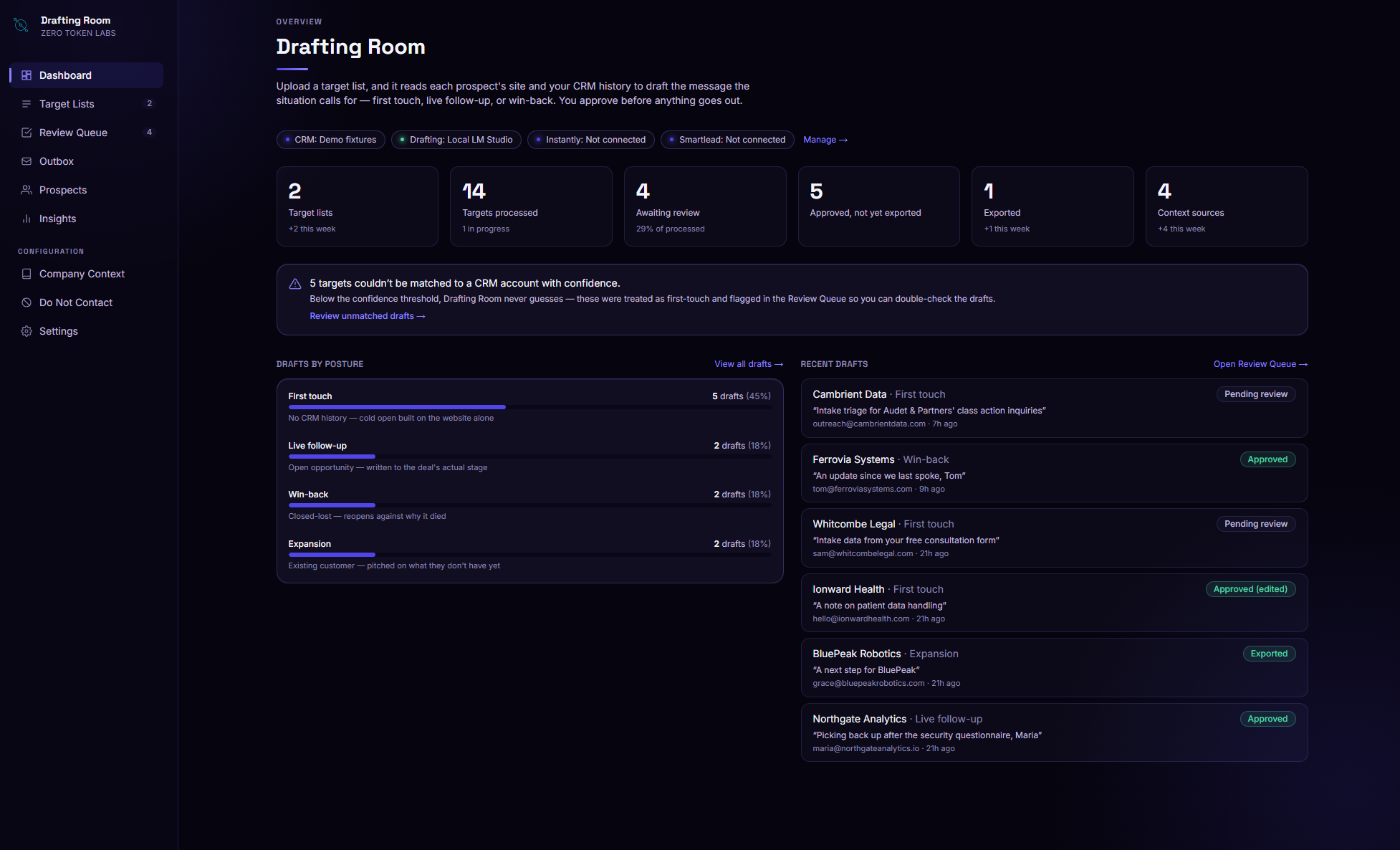
You bring the list. It reads the outside world, reads your CRM, works out which situation you're in, and writes the message that fits, then hands it to you to approve.
The chain
- Bring your list
- Read the site
- Read Salesforce
- Draft the message
- You approve
Live · The Dashboard
Every draft, staged and accounted for
03 · The Context Layer
What Salesforce tells it
The email domain is the key. It resolves to an account, and the account resolves to a history. That history decides whether you're writing a pitch, a follow-up, or a second chance.
Read from the account record
- Open opportunities
- Stage
- Amount
- Close date
- Next step
- Closed-lost
- Loss reason
- Churned accounts
- Churn reason
- Notes & comments
- Activity history
- Account owner
| What Salesforce says | Posture | What the message does |
|---|---|---|
| No account, or no confident match | First touch | Cold open, built on what the website reveals about their gaps. |
| Open opportunity in the pipeline | Live follow-up | Written to the stage the deal is actually in. Picks up the last note and the agreed next step. |
| Closed-lost or churned | Win-back | Reopens against the reason it died. What's changed since is the argument. |
| Closed-won, no open opportunity | Expansion | Speaks to an existing customer as one, against what they don't have yet. |
04 · The Math
Three ways to send five hundred messages
We'll be direct about the alternatives. You can hire more SDRs. You can buy an enterprise AI sales platform. Or you can run this on your own hardware. Each one works. They cost you different things.
| Dimension | More SDRs | Cloud AI sales platform | Drafting Room |
|---|---|---|---|
| Reads your CRM history | From memory, under pressure | Yes, in their cloud | Yes, inside your perimeter |
| Where your loss notes go | Nowhere. They stay put. | Uploaded to a third-party vendor | Nowhere. They stay put. |
| Cost model | Salary, ramp, turnover | Per seat, per credit, per token | Flat rate, on hardware you own |
| Cost at 10× the volume | 10× the headcount | Scales with usage | Unchanged |
| Requires their data & sequencer | No | Usually; that's the business model | No. Your list, your stack. |
| If you stop paying | n/a | The pipeline stops with it | The hardware is still yours |
| Human review before send | Yes, and it's the bottleneck | Optional, and often skipped | Required, and it takes seconds |
05 · Sovereign, And Yours
This is why it runs on your hardware
Nobody needs sovereign AI to write a cold email. The moment the model reads your CRM, that changes completely.
Your Salesforce notes are the most candid text your company owns. Champion left. They thought we were overpriced. Legal killed it over the DPA. That is your negotiating position and your loss patterns, written down in one place.
Every cloud AI sales platform requires you to send that off-premise. That's not a footnote in their architecture; it is their architecture. Drafting Room reads your CRM inside your perimeter, on hardware you own. Nothing leaves.
On your infrastructure
Bare-metal, on-premise, priced flat rather than metered. You're not renting access to a black box.
Read-only, least privilege
A scoped, read-only integration user. It never writes to your CRM and never sends on your behalf.
Every message,in context.
Point it at a sandbox of your Salesforce and a slice of your target list. We'll run a sample batch so you can see the drafts, and the postures it picked, before you commit to anything.
Schedule an infrastructure auditAlso from Zero Token Labs
Deal Ledger.
A CRM auto-update agent: every call, email, and Slack thread a rep has gets read, checked against your rules, and written to the CRM, usually before the rep has hung up the next call.
Promise Track.
A commitment accountability agent: every promise made in a call, email, or thread gets captured in its exact words, linked to the account and the owner, and chased to fulfillment before the customer has to ask where it is.