
Product
Deal Ledger.
A CRM auto-update agent: every call, email, and Slack thread a rep has gets read, checked against your rules, and written to the CRM, usually before the rep has hung up the next call.
Every write logged, with the sentence that justified it.
01 · The Problem
The CRM is always a few calls behind reality
Reps don't skip CRM updates because they're careless. They skip them because updating a record properly takes longer than the call did.
So the fields get filled in later, from memory, inconsistently, or not at all. By the time a manager pulls a pipeline review, half of it is a guess.
One of our own pilot conversations put it plainly: our forecast is fiction because the CRM is three weeks behind reality. That's not a rep being lazy. That's what happens when the system asks a human to do data entry as a second job.
4 hrs / wk
Lost per rep to manual CRM hygiene. Friday afternoons reconstructing the week's calls.
3 weeks
How far behind reality a hand-updated pipeline runs by the time anyone notices.
Zero
Fields updated after a real call where next steps, budget, and a decision-maker were agreed.
02 · The Pipeline
Three tools, one deal, no human in the loop until it matters
Every interaction runs the same chain. Nothing reaches the CRM without first being read, checked, and, if it fails a rule, held for a human instead of guessed at.
The chain
- Ingest the call, email, or Slack thread
- Extract the fields it supports
- Check the guardrails
- Write to the CRM, sandbox first
Live · The Dashboard
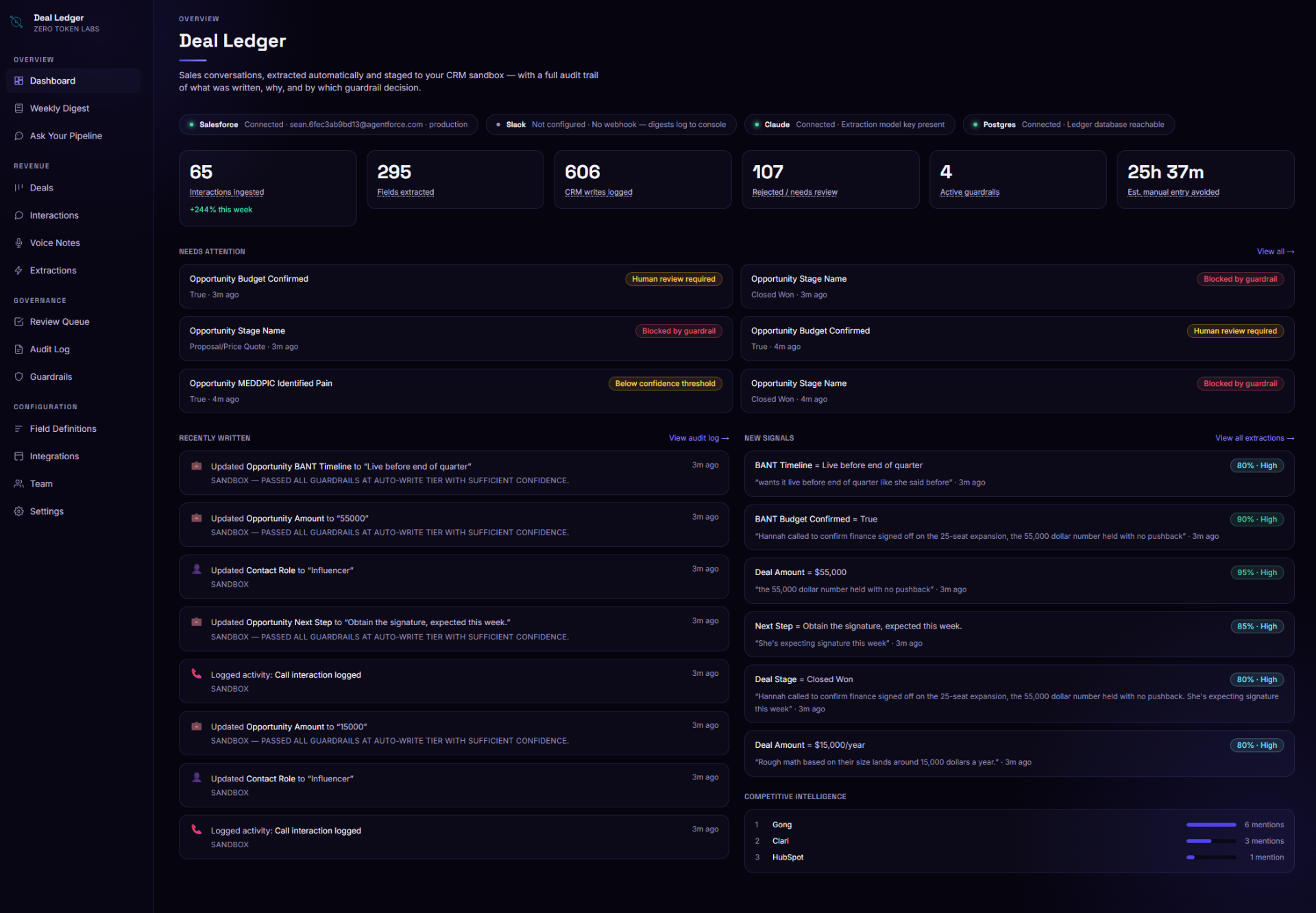
Every write, staged and accounted for
03 · Guardrails, Visible
The system says no as often as it says yes
A rule engine is only trustworthy if you can see it working. Every guardrail is a plain sentence, not a JSON blob buried in config, and every rejected write lands in the same audit trail as every accepted one.
- A deal can only move to "Closed Won" once Close Date Confirmed has been captured.
stage_transition - Budget Confirmed is human-only. The agent never writes it, no matter the confidence.
field_permission - New Opportunity records are created only from call interactions.
record_creation
04 · The Math
Manual entry vs. the ledger
| Dimension | Manual entry | Deal Ledger |
|---|---|---|
| Time to update a field | Whenever the rep gets to it | Minutes after the call |
| Consistency | Varies by rep, by day | Same standard, every call |
| Audit trail | Usually none | Old value, new value, source sentence, confidence |
| Judgment calls | Silently guessed | Explicitly gated: human-only fields, confidence thresholds |
| Duplicate records | A recurring cleanup job | Matched before anything is created |
05 · Sovereign, And Yours
Connected to your CRM, not a subscription to ours
The credential that lets this write to Salesforce lives in your own database, encrypted, through a one-click OAuth flow you control. Not a shared login, not a third party holding your refresh token.
On your infrastructure
Extraction, guardrail, and write-back logic runs as a dedicated server you control end to end.
Your data stays yours
Every interaction, extraction, and write is your own audit trail in your own Postgres instance.
Your CRM,finally current.
Want to see it run against your own stage names, your own field definitions, your own Salesforce sandbox? We'll wire it up before any of your reps notice.
Schedule an infrastructure auditAlso from Zero Token Labs
Drafting Room.
Reads the prospect's website, reads your Salesforce account history, and drafts the message that situation actually calls for, whether first touch, live negotiation, or win-back.
Promise Track.
A commitment accountability agent: every promise made in a call, email, or thread gets captured in its exact words, linked to the account and the owner, and chased to fulfillment before the customer has to ask where it is.